It was all Laura’s fault.
“Hon, if we’re going to Tanzania, can we visit a game park? The kids would love it.”
“I’m going home after thirty years. I thought we could spend a week in Dar-es-Salaam, looking up relatives and friends I’ve lost touch with. If we go to, say, Serengeti, it’ll cut our time there to two days.” I was not a happy camper.
We arrived at Dar-es-Salaam’s purportedly brand-new airport. The beautiful violet bougainvillaea had been decimated to make way for several runways, but we still had to walk in the sweltering heat and dust from the plane to immigration. Rancid-smelling baggage handlers darted in and out of our line like bandits, collecting luggage by hand. There were no carts, trailers or trolleys to assist them. We stood in line under the baking sun as three passport officers examined a hundred passengers. The doors to their office were wide open, only to let in fiery gusts of wind and dust inside. There was no air conditioning. When our turn came, an officer lent us a pencil—the only one he had. There wasn’t enough light to read, let alone complete the flimsy paper questionnaire. No lightbulbs—only empty sockets lined the ceiling.
Welcome to Africa.
Our once-beautiful harbour town was no more. Racing home in a battered taxi, our hearts jumped to our throats as we were catapulted from one pothole to the next. The population seemed tenfold what it was on my last visit. Palm trees once fringing the bay were gone. The main street—once Acacia Avenue, named for its immaculately lined boulevard of trees—barely boasted of one. It had been renamed Samora, after an African rebel leader who also pillaged neighbouring Mozambique.
No one remained from the community I had grown up in, nor remembered any of their names. East Indians like me had migrated to Dar-es-Salaam from the interior, vainly seeking work or any opportunity to survive. Their desperation was mirrored by the buzz of native Africans swarming around us, offering to exchange currency, help with the internet, or even female company—despite us clearly walking as a family: husband, wife and two boys.
Thank goodness, I had been outvoted in Canada and booked a trip to Serengeti. Even two days in this city were too long.
Having commuted between Western and Eastern communities since childhood, I can understand—though not necessarily condone—why East Indians were summarily expelled from Africa. We treated the native Africans a notch above slavery. Every one of our households had its complement of servants, paid a pittance—likely less than the cost of one meal for a family of four. We’d “generously” hand down shirts yellowed with age, hole-ridden, cuffs and collars frayed. The servants ate our leftovers outside in the blazing sun, then washed our dishes—always at a tap and concrete square at the back of the home. They were rarely educated, constantly scolded and insulted.
Now living in Canada for 45 years, I see similar treatment of our First Nations people—still fighting to be heard and granted their rights.
To assuage my guilt, I deliberately chose a black-run safari operation—most were operated by white South Africans or local East Indians in ultra-modern, air-conditioned Land Rovers. White Sky Safari (as the African boys called themselves) was a different experience altogether.
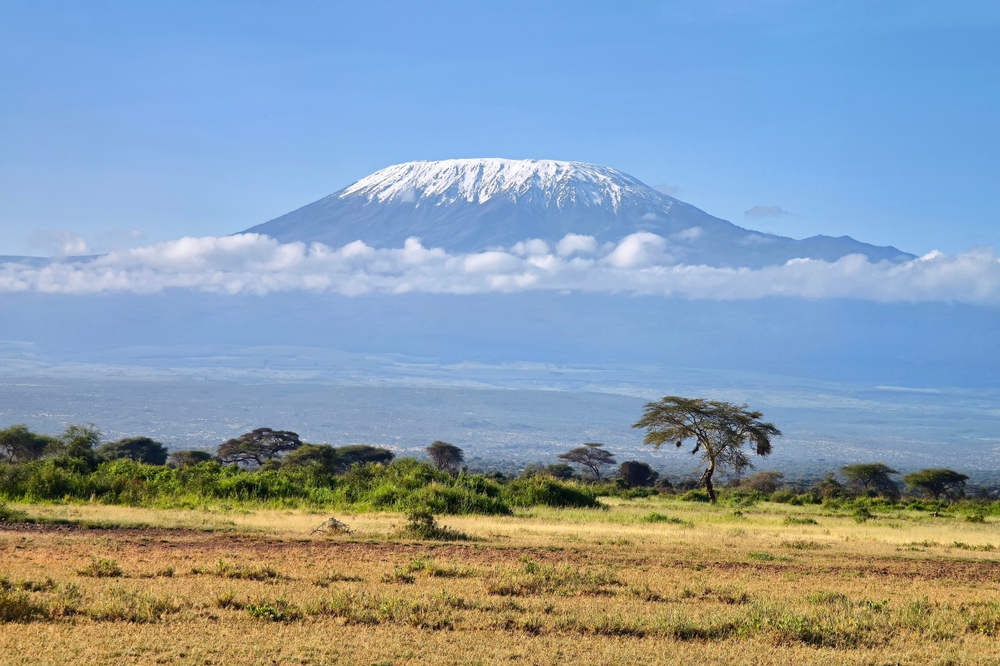
On our way, we hovered over Kilimanjaro airport—halfway between Arusha and Moshi on the northern border with Kenya—skirting the highest mountain in Africa, breathlessly beckoning. Laura and the boys scurried from porthole to porthole, snapping photos on their iPhones.
This “modern” provincial airport truly was modern, although we still had to walk to the terminal. It even accommodated jumbo jets flying in directly from Germany. The one-storey, clean terminal really was air-conditioned.
At its entrance, we were met by Shabani and Juma. There was an immediate connection.
“It’s evening. We’ll drop you at your hotel. You can eat there and relax.
Tomorrow, we’ll pick you up early—at six.”
After a meal—fried fish with chunky hash browns, fried Indian-style in turmeric—the boys wanted to venture out.
“Is it safe?” I asked the concierge.
“Of course!” In Dar-es-Salaam, we’d been warned never to leave our hotel grounds after 7 p.m.
First impressions: few pedestrians. In the capital, there was barely space to walk side by side. Here, we had the place to ourselves. The air was fresh and invigorating—unlike the fumes and dust of Dar. I saw a vendor sitting cross-legged at a street corner, selling my favourites—jackfruit and matufas. Jackfruit: silky, thin, bright yellow slivers of fruit surrounding a seed the size of a conker. Matufas: shaped and coloured like pink-red apples, hollow inside with a small seed. Bite into one and it peels away like a thin shell—strangely reminiscent of candyfloss.
Our Land Rover arrived on time, though not the sleek, air-conditioned vehicle boasted by other operators online. Shabani and Juma sat up front, driving and guiding. We had three rows of seats to ourselves—luxury. The air-con sputtered, sank, then revived. Half an hour in, a pop beneath us: a flat tyre. A common hazard on Africa’s untarmacked roads. Our guides jumped out, changed the tyre, and we were off again within half an hour.
We spent a day in Serengeti—lush, wild lands where we saw our first giraffes. Our Rover parked beside a shallow waterhole. A large, flat, grey-black “rock” began to move—it was a hippopotamus. A group of hippos, submerged in the silt, stirred and rose to follow. There were Thomson’s gazelles, wildebeests, monochromatic zebras, elephants… everything you’d imagine in a game park. We witnessed two cheetahs devour a baby antelope just feet from us. They glanced up, then resumed their kill.
Not being the adventurous sort, we declined camping, opting for a Sopa Lodge for our overnight stay.
The next day, our Rover stopped at a break between trees. Shabani jumped out and opened our doors.
“Come with me,” he said, then stopped us immediately.
We were on the edge of an imploded volcano—a caldera. At the bottom: tall wild grass, animals, a worn path circling the valley floor. Two more paths dissected the ring. Land Rovers filled with tourists traversed them.
This was the world-famous Ngorongoro Crater. It looked like a scene from Jurassic Park.
We remained at Ngorongoro for two days, criss-crossing the crater repeatedly. Juma raised our canvas roof on stilts. The boys could stand and take pictures. The bumpy roads sent them bouncing around—delighted. Though the path was the same, each trip revealed something new. One day, we passed a solitary lion resting in high grass. The next, a lioness popped up so close we could have stroked her. Suddenly, a pride of lionesses rose from the grass, frightening us out of our skins.
Our final stop was a cluster of mud huts—no idea why. Upon arrival, we were served ice-cold cups of tangy, pinkish-maroon liquid: iced hibiscus tea. Back in Calgary, we found it again in a Jamaican restaurant—there, they called it sorrel.
On entering our hut, I flicked on the light. Nothing. The phone didn’t work either. At the large reception hut, I was told it was another blackout.
“Don’t worry—we have them all the time. Our generator’s always overworked.”
Power resumed a few hours later.
In the morning, I woke early and decided to walk around. Our hut sat on the edge of a lake. A crocodile’s jaw lazed just above the surface. But the most breathtaking sight: the water had turned a shocking pink… hundreds of flamingos floating gracefully. I dashed back to wake my sleeping family.
It wasn’t the animals I remember best. Oddly, it was the mottled fruit sold by street vendors—treated as commonplace. When have I ever found mottled fruit in a Canadian supermarket ? All perfectly shaped but tasteless ? I still salivate at the thought of ripe matufas.
The people impressed me. In Dar-es-Salaam, it was all about survival. In Arusha, people were optimistic—hopeful. That hope fostered hospitality. The town was booming. Newspapers spoke of Tanzania’s economic resurgence. In the south, vast reserves of natural gas had been discovered offshore. Could the government curb corruption long enough for a new generation—energetic, enthusiastic and optimistic—to prosper? Judging by what I saw outside my birth city, yes… in bucketloads.
It was that hope which rekindled my love for a country I had called home since childhood.
At Kilimanjaro airport, my boys hounded me for cash.
“Why?” I asked.
They wanted Tanzanian national football shirts and beaded bangles in the colours of the national flag. Out of their boredom and despondency in Dar-es-Salaam, they were now rejuvenated—finally connected to this country I so loved.
Staring out of the plane porthole, awed by the majesty of Mount Kilimanjaro, Chris nudged me.
“Next time, can we climb the mountain?”
“Perhaps,” I said. “If you’re as blessed as we’ve been, you will. But taking your own wife and kids along with you.”