“Rapa, poom, poom, poom.”
“Rapa, poom, poom, poom.”
We can hear the sousaphones pumping from ten blocks away, off Frederick Street, Nassau. It’s Junkanoo time in The Bahamas.
“Hurry up, kids — and Laura. We’ll be late.”
The taxi drops the four of us at the corner of Elizabeth Avenue and Bay Street. It’s the early hours of Boxing Day.
“Sorry, sah! This is as far as I can take you,” the cab driver apologises.
“How can we get to Rawson Square? Where the grandstand is?”
“If you haven’t got tickets, you’ll never get in. Go down Elizabeth Avenue.
Turn right into Shirley Street. You’ll find plenty of free trestle seats along the road. The Junkanoo is way behind — you’ll have time.”
It’s 2 a.m., and we’re working our way through the madding crowd. The sousaphones approach ever nearer, ever louder. Now we hear goatskin drums and clanging cowbells. Roars erupt from the crowd. All around us, people stamp their feet in rhythm to the deafening music.
“Para, rum, pum, pum.”
“Para, rum, pum, pum.”
I rush my family through the milling throng. Miraculously, the crowd thins. For some reason, the parade — as loud as ever — has remained stationary in front of Rawson Square, facing Parliament House to salute its dignitaries.
Shirley Street, two blocks parallel to Bay Street, is relatively quiet. There are rows of two-tier steel scaffolding seats and plenty of space.
A mother cradles two little boys with bleary eyes — little black angels on either side of her. We plonk ourselves down beside them. The weather is perfect: warm enough without making us sweat, the occasional breeze cooling us.
The boys, probably a year apart, wear their best Christmas clothes — identical bright red polo shirts and black formal trousers. Their shoes, and their mother’s clothing, tell a different story. I look at us, dressed in hand-me-down, torn jeans and T-shirts — inverted decadence. Sitting beside one of the angels, I’m tempted to tousle his hair. His mother smiles at me. As I lean closer, I see a price tag still attached to the back of the boy’s collar.
I remember arriving in England as a five-year-old, brought up by a poor English family with six children. Once a year, new clothes were bought, first worn at Christmas. Throughout the year, Nanny knitted endlessly, making us cable sweaters to complete our outfits. Whether we attended church or a choir service, it was a very special occasion — something to be proud of. I look at my family today: the “occasion” treated as mere entertainment.
The cacophony approaches. The two angels wake, invigorated, stand beside us, dancing and clapping. There’s no one behind us to obstruct the view.
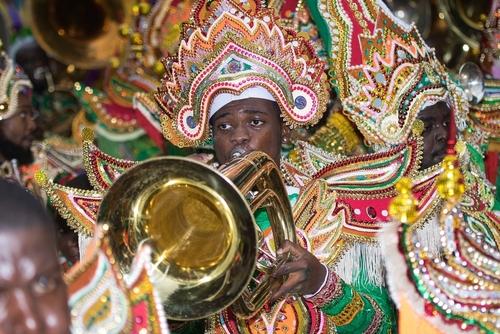
Shirley Street, once empty, is now stacked with phalanxes of musicians and dancers in outrageous, colour-splashed outfits. Each costume is handmade from paper and cardboard, embellished with silver beads and shards of glazed pottery. Paupers transformed into magnificent royalty.
The parade passes. It’s now 6 a.m. We wend our way home in a taxi.
At two in the afternoon, we return to the scene. The Junkanoo is still going. Bands can be heard far down the street. The road is littered with glittering fragments of costume. I stoop to retrieve a cardboard breastplate as a souvenir. I walk my family down Elizabeth Street. There’s a water tower we can climb — it offers an unparalleled view of Nassau harbour. It’s the perfect day for photographs.
Suddenly, a voice bellows at us. “What are you doing here?”
It belongs to a tall, dark man wearing a doctor’s white coat, a stethoscope hanging from his neck. “This area is dangerous. Never venture north of Bay Street on your own. Come — I’ll escort you back.”
I suddenly realise we haven’t eaten. “Where do you go for lunch?” I ask.
The doctor takes us to the far eastern — and poorer — end of Bay Street, to the V.I.P. Chinese Restaurant. “You’ll be safe here. Follow this street back to the harbour. You won’t be harmed.”
To the tourist in The Bahamas, everything is expensive: the service poor and slooow. Fifteen per cent is added to the bill before tips. A meal for four easily costs US $120.
We enter. The restaurant is packed with locals and Filipino seamen. It’s a standard Chinese restaurant, run by a wizened Asian and served by local women. The food is delicious — fresh and plentiful. There is no service charge, nor Coca-Colas at $10 apiece. The entire meal costs us US $30.
Every time I talk to a stranger, Laura cringes with embarrassment. However, she never stops me. I talk to Delia, the waitress, about Junkanoo and our failure to find tickets for the grandstand at Rawson Square.
“Junkanoo is repeated on New Year’s Day. I can find you tickets, but they’ll cost $50 each.”
I empty our pockets to produce the US $200.
Laura is livid. “How can you trust a stranger — and in this run-down area — with so much cash?”
Delia delivers.
It’s our final evening in The Bahamas. We sit fifteen rows above the ground at Rawson Square, with the whole of Bay Street spread out before us.
The sousaphones start, the dancing begins, and we follow the participants from the start of their journey. As they approach, Laura and the boys are ready with cameras and iPhones.
Suddenly, the entire bench in front of us stands and begins gyrating to the impossibly loud music, completely obliterating our view. My poor wife and children duck and weave, trying to salvage at least one good photograph of the parade.
I sit calmly amid the maelstrom, smiling at the irony of my life, remembering the two little black angels and my English family — who delivered the world to me from out of nothing.