Continued from Part I
For a full day we had been isolated on a oversized tugboat ferrying us from Cyprus to Egypt. All we could do was plod around the deck taking pictures of the sea. Finally, our boat anchored in the harbour of Alexandria. At last, we were free.
A petite local guide, Marwa, came to greet us. She must have been 4’9″. At my 5’4″ height, I towered over her.
“Your luxury, air-conditioned coach is over there waiting for you,” Marwa said. “I have a pointer.”
Her pointer was an extended silver aerial. At its top, an Egyptian flag.
“Whenever we reach a site,” Marwa said, “I will hold my pointer up so you can see me always. I will shout ‘Attack’ and you will stand as close to me as you can.”
There was no time to see Alexandria. It was a coach trip to Giza, to the Sphinx and Great Pyramid, a quick lunch, and then a tour of the Egyptian Museum of Antiquities.
“Pops,” Chris, my younger son, cried out. “Why is there an army jeep with a mounted machine gun driving behind us? There’s another jeep with the same gun in front of us.”
Marwa overheard.
“There have been some minor incidents recently,” she said. “We will have an army escort throughout to protect us.”
“Protect us from whom?” I asked myself. This was never mentioned.
On the way to Cairo, I saw the top half of a ship laden with containers behind a rail line, a clip straight out of Lawrence of Arabia, a 1962 film loosely depicting First World War battles in the desert. Marwa chimed in, “We are driving parallel to the Suez Canal. You can’t see the water because it’s hidden behind an embankment.” Only the top of the ships can be seen as we pass them.
We entered Cairo and chaos. The smell of dust, the dirt, an overwhelming madding crowd. The echoing blare of a Muezzin’s call to prayer. A circus of every kind of transport, from donkey-drawn carts to Mercedes lorries. The noise of engines and horns, the potent smell of petroleum fumes almost made you vomit. Tall apartment buildings, dark with grime, appearing to be made of mud and leaning over. Giant birds’ nests atop, large enough to house two people, jutted out over the traffic below, staring down at us. While Laura gazed transfixed at what the city had to offer, her face flat against the window, I only had eyes for her. Here was a woman immaculate and clean; everything under her wing so well organized. The turmoil of Cairo should have been the last place on Earth to please her. Yet there she sat, like a little child starstruck.
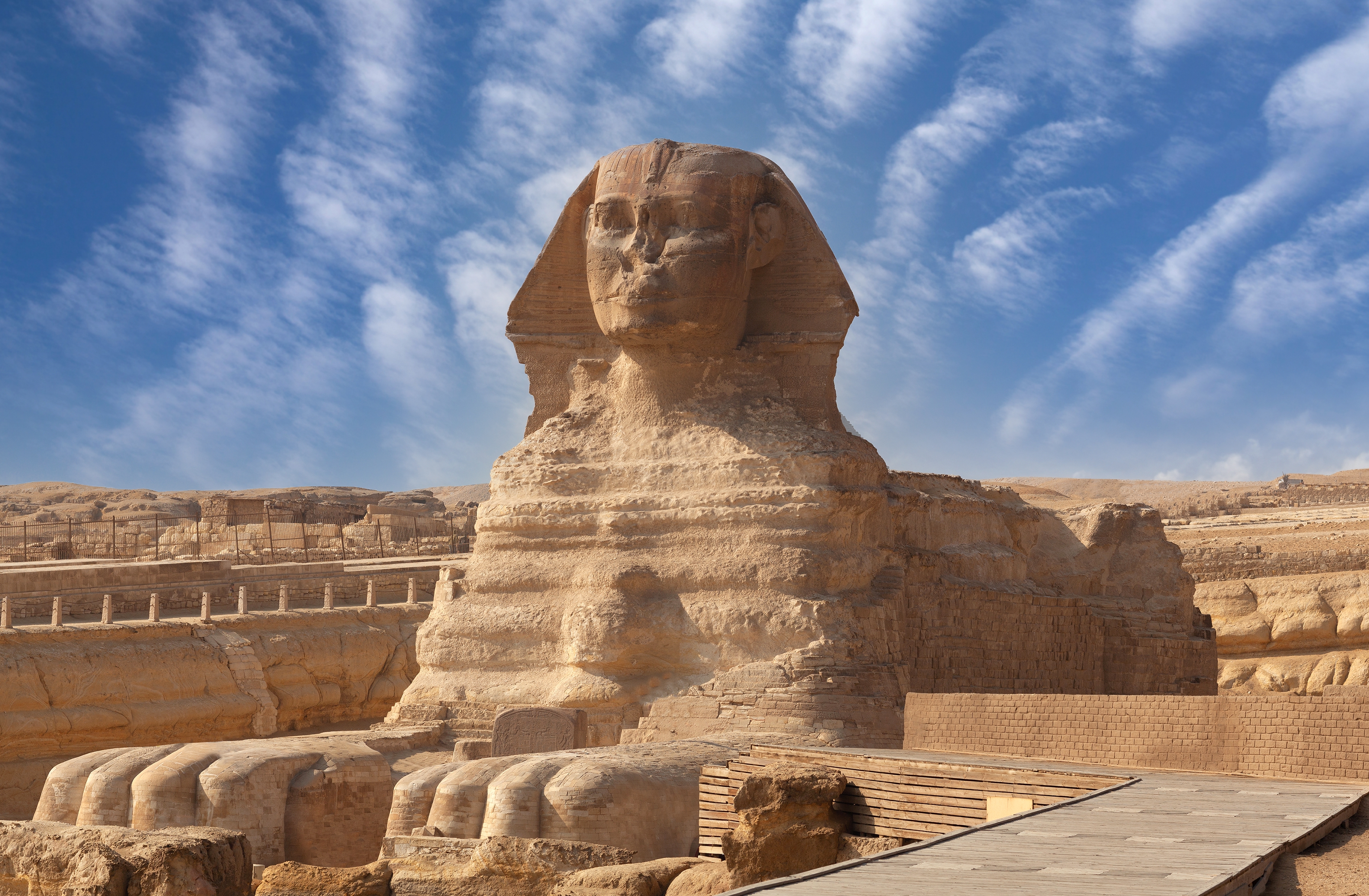
Ah Giza! The Great Sphinx, with the head of a human, the body of a lion in repose. Having spent years in school studying Ancient Egypt, the Sphinx seemed to me so small, almost like someone carved a miniature for our pleasure. The face is pocked; its nose smashed, all thanks to Napoleon’s sharpshooters who came in 1798 and used the Sphinx’s head for target practice. The Sphinx may have shrunk in my estimation but the Great Pyramid of Khufu, built around 2600 BC, rests its case as the only surviving Wonder of the Ancient World.
We ate at a local bakery. Oh, the smell of fresh bread, za’atar, a pizza with a spread of toasted sumac (black seeds tasting of lemon), seemingly burnt to cinders, but no taste of it save the sumac and olive oil fresh out of the oven. And the dessert pastries, basbousa (syrup-soaked semolina cake), umm ali (creamy puff pastry pudding) and so much more all washed down with thick, chilled mango juice, bearing nothing but pulp.
It was late afternoon. The air conditioning on our coach lulled us to sleep until our bus abruptly halted at the Museum of Antiquities. Marwa comes to the fore, ordering us to “attack” in every direction. Her tiny body forced its way through the crowd. Her guests chasing after her.
Here were sights to be seen: the Mask of Tutankhamun, as resplendent as when it was created in 1323 BC, of gold, lapis lazuli, carnelian and turquoise, weighing 321.5 troy ounces; countless jewellery and statuary. Unlike visiting the Louvre in Paris, France, where you stand in a room with 50 rows of people in front of you to examine the Mona Lisa from afar, its portrait appearing the size of a postage stamp, here in Cairo, you stand with your face inches from the Mask of Tut…. it felt large and momentous.
“One last stop!” our venerable guide bellowed.
What is it? A local McDonald’s was the wish of my boys.
No.
We walked through narrow, crowded lanes then down some stone steps, entering a basement workshop. There, men, sitting cross-legged on low and long daises, were working away at intricate papyrus drawings in every colour of Tut’s Mask. It was a veritable Aladdin’s cave.
Laura and the boys idly touched raw papyrus, the stuff of dreams imprinted upon them: armies of men on chariots, depiction of fertility rites, of the Gods Ra (sun), Amun (creator), Osiris (underworld), Isis (motherhood) and Horus (kingship). I went crazy and bought six of the largest papyrus scrolls and three smaller ones. Stunned, Laura asked, “Why are you buying so many? We have no space in our home to hang them.”
“One day we will,” I remarked.
Marwa allowed us an extra half-an-hour at the workshop while the rest of our group retreated to our coach. The little woman was full of glee. The commissions she’d earn from our purchases would pay towards her daughter’s university education, “Not to be a mere dragoman like me, but a pediatrician to help babies survive.”
On the seemingly endless trek back to Alexandria and home, I dwell on the magnificent grandeur of ancient pharaohs, the utter vandalism of “civilized” French voltigeurs and the universal symbol of a mother daring to dream for her child daughter.
Twenty years later, with our larger home renovated, our walls are covered in framed papyrus, welcoming the gods and rituals of ancient Egypt into our home.