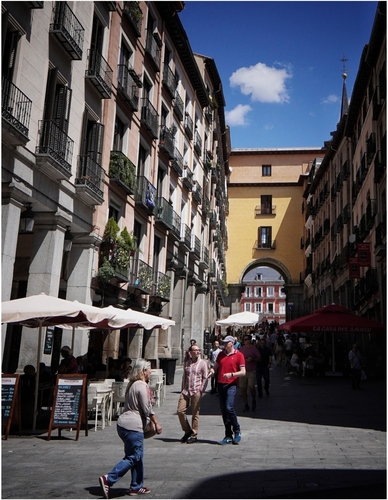
The merciless heat, dust and incessant squeeze of the horde at the Royal Palace of Madrid had drained us. Entering Calle de Bailén, we were parched. At this time in the afternoon, the broad, gently curving boulevard was deserted, its inhabitants presumably catching their siesta. Tall trees provided occasional canopied havens from the brutal sun. A sporadic breeze cooled us down.
To Laura’s great disappointment, the Basílica de San Francisco el Grande, grandest of Madrid’s venerable churches, was closed for the afternoon. I sighed with relief. An hour saved in our whirlwind tour of the city in a day.
Our spirits sank further under the oppressive heat, not knowing how long we had left to trudge to our next destination. Every shop was boarded shut. Not a soul in sight. Suddenly, Aladdin’s cave opened before us. It may not have lavished diamonds and rubies, but something now more precious – water and sustenance. In the whole five kilometres of our trek, only this mom-and-pop store remained open, soldiering on. The shop was the size of a cubicle, barely enough room to walk through.
The entrance door stood open to catch any breeze it could. There was no air conditioning. The heat within was intolerable. An elderly Korean couple stood behind a makeshift counter and gave us a weak smile. According to a sign stuck to the window, the shop was open seven days a week, twelve hours a day. An aroma of ginger and garlic wafted throughout. I assumed it was the smell of cooking from the back of the premises, where the owners lived. They had left the door to their private quarters ajar. I sneaked a peek. Alex crept up behind me.
“Pops,” Alex whispered, “their home is no bigger than our garage.” He appeared discomfited. “Imagine – that palace down the road we just visited had 2,800 rooms. Half of them were empty. How can they allow an old couple to live like this? I couldn’t take it for a week.” Sweat was spreading across both our foreheads. In our extensive travels, we had encountered injustice everywhere: individuals, generally immigrants, running themselves into the ground to serve, to survive each day.
Within the labyrinth of narrow, crooked passageways, we discovered three slim coolers packed together, bearing ice-cold drinks. Shelves slumped, overburdened with sweets and snacks. The boys grabbed packs of homemade fruit nougat, Laura a cache of bottled water.
Out on the street again, a few more kilometres delivered us back to the city centre. A subway disgorged its passengers into us. Chris leapt towards a restaurant, pulling Laura along with him. We hadn’t eaten since early breakfast. The place, slightly grungy, was filled with locals: workmen in yellow neon-taped jackets, their safety helmets dangling by their straps from the backs of their chairs; wizened old men absorbed in a game of cards; and buxom matriarchs cackling to each other.
“Mum, they have seafood paella, but it’s for two people. Can we share?” Chris – lanky and underweight – had been a fussy eater all his life… until we started travelling. Pops smiled to himself. This kid was now ordering rice brimming with clams, mussels and squid, as though they were bosom friends. Twenty minutes later, a large, battered, blackened pan, its fiery orange-yellow saffron rice steaming and simmering, was thumped down in front of us, exuding the welcome fragrance of smoky fish competing with an abundance of spices.
Bellies full, we continued our journey. Alex fished out a map, leading the way.
We entered a medieval world. The street narrowed. Tiny shops – centuries old – purveyed harnesses and ancillary equine paraphernalia. A baker invited us to purchase galettes – flat, round, open pastries topped with freshly sliced fruit. The aroma of newly baked bread was overpowering. His neighbour sold flags and heraldic pennons.
Our path ended at the foot of a steep set of wide, stone steps.
“Lex, are you sure we’re on the right road?”
“Of course,” he replied without hesitation.
Several steps later, husband and wife were panting for breath. For a moment, they paused, gazed up longingly at their boys and exchanged a smile. Thirty years together, their communication verged on telepathy. “Once we had to hold their tiny hands to coax them up the steps. Look at them now.” He squeezed his wife’s hand.