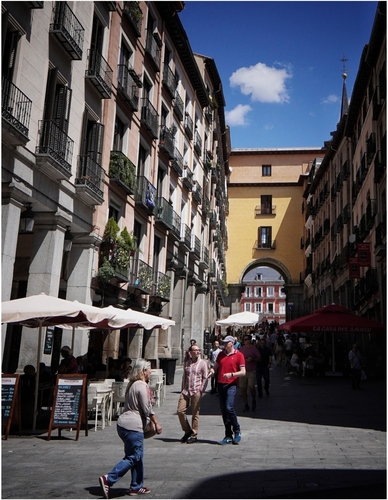
At the top of the steep stone steps, a large, ornate stone arch greeted us – the Puerta de Toledo – one of several gates converging onto the Plaza Puerta del Sol, the grandest of Madrid’s squares.
Once again, the scene teemed with tourists. Everyone barged into each other. I constantly felt for my wallet. “Don’t stay too long in the centre. Too many pickpockets,” a friend had warned. I scouted the area. A thief could easily prosper in this environment.
Plaza Puerta del Sol must have been a mile long. Statues, fountains and sightseers mingled into a confounding, bustling blur. Afterwards, all I could remember were the life-sized sculptures of Las Meninas in every nook and corner: beautifully formed women, with wide, burgeoning dresses in brilliant, variegated colours. They were made of highly glazed porcelain, inspired by Velázquez’s Ladies-in-Waiting portrait. This was the annual Las Meninas de Canido festival.
“Hon, can you take a picture of us, please, beside one of them?” Laura asked.
Focusing the camera, the boys were taller than the six-foot mannequin. Between them stood their mother. Laura reached their shoulders in height. When they first began travelling, the boys were waist-high to their parents. Would we ever have a chance of being together like this again? I imagined our boys married with children of their own, inviting Mum and Pops to accompany them on their own family travels.
“Smile,” I cajoled. Laura could barely do so. She tried bravely, her shoulders slumped. The boys, meanwhile, were full of pep and vinegar. There was a time when they were small and easily tired; Laura would carry the younger Chris in her arms, while the heavier Alex rested on Pops’s shoulders, mussing his father’s hair like a mahout on an elephant, gently swaying from side to side. His father’s hair had long disappeared, as had his parents’ energy.
Photos taken, the boys were on the run again. “Come on, Pops, to the Prado Museum next.” Once again, Alex took the lead, his brother matching him stride for stride. They dashed through the square as best as they could. Mercifully, the surge of tourists thinned as they left the plaza.
Laura needed a bathroom break. The Westin Palace Hotel came into view. “Come. In there,” I beckoned. They entered, wearing shorts and dusty sandals, their T-shirts drenched in sweat, walking into the most luxurious, plush-carpeted, elegantly appointed reception, enquiring after a washroom.
There was neither embarrassment nor snootiness evinced by the staff, nor any question asked if we were guests. “Down the corridor, sir.” The wide baroque way led to a large rotunda, topped by a stained-glass dome. Beneath it hovered an exquisite crystal chandelier, sprouting a hundred candles. At its epicentre, the elite of Madrid society sat at a lavish brunch buffet, serenaded by opera stars. Every haute couture piece of clothing, footwear, clutch bag, jewellery and half-a-million-dollar chronometer by Richard Mille was on display.
Yet we were welcomed with open arms to join them. By my family’s expectation, it was completely out of character. But on every trip there arrived this totally awe-struck moment – the priceless unexpected.
As we left, the final bars of Nessun Dorma rose to its crescendo. For the first time today, our family halted as one, swept away by the music – frozen in time.
Nessun Dorma. “Let no one sleep.” All our past travels rolled before me like a magic carpet. I had watched my boys grow up, marvelling at the heights they had climbed. Once again, I was reminded it was our last adventure together. I wished it would never end – that we would not surrender to sleep. For to sleep was to awaken back home, full of memories and nothing more.