Continued from Part III
What possessed me to flout my mother’s counsel?
As a baby, when dandling me on her knee, she had warned ,” NEVER go into business at the same time with two Jewish-Russian ladies with the same first name, one opening a haute couture ladies’ clothing, the other a high-end Russian restaurant. “She may not have been psychotic, but she was definitely psychic.
Yes, I may have been young, gifted and black ( or rather, brown) but all I could answer at the time was “ Goo-goo, ga-ga, goo-goo-goo”, then, on arriving at man’s estate, follow my Russian partners like a lemming, jumping over a cliff into oblivion.
To start the schmatta business with Anna S., I scurried into every corner to find $300,000 and more. At the same time, I committed to raising at least $100,000 for Anna L. to realize her dream of opening an out-of-this-world Russian restaurant. In hindsight, both ventures proved to be extremely under-financed. My quest became a highwire act. I managed to cobble together a patchwork of personal lenders for Anna Moda couture. But now, with all my resources tapped to the hilt, who else could I approach?
The (hell’s) angel materialized in the form of Harry, my erstwhile Jewish client, who had first introduced me to Anna L.’s kitchen and its mile-long lineup to get in.
Anna L. had a duplex with enough equity to secure $50,000 from Harry , who was himself a real estate mogul. He loaned me the additional $50,000 on my personal guarantee.
In both enterprises, I was responsible to raise the money and, being an accountant, keep the books. The two women would design and run the businesses.
It was a slice letting Anna S. manage and set up our boutique. Her Moscow University degrees in engineering, design and fashion resulted in our renovations coming well within budget. Anna L.’s marketing skills, through her prior high-end ladies’ shoe business in Calgary, brought in truckloads of customers, all rich and ready to splurge.
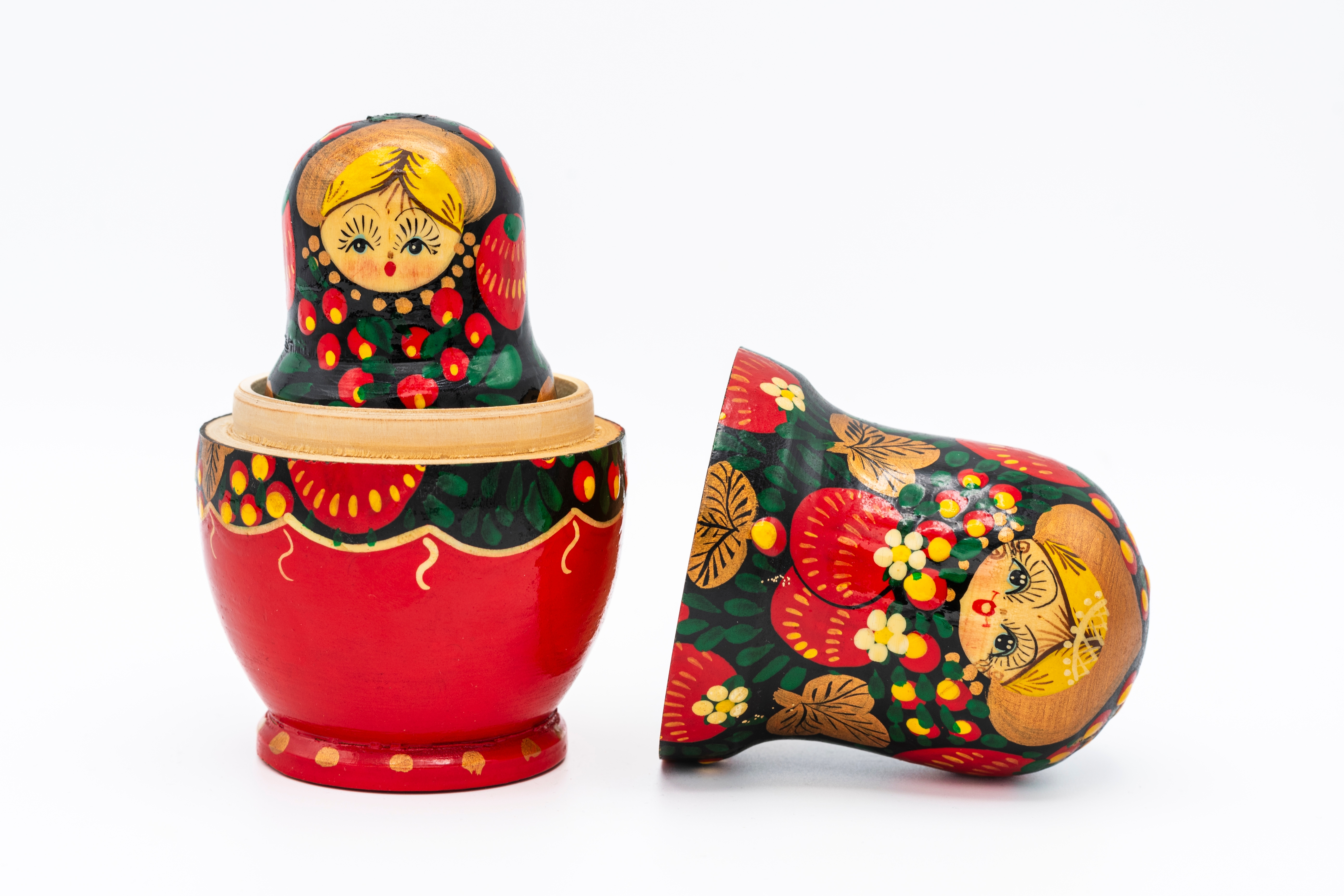
Anna L. was a totally different proposition. All she had ever managed was a household kitchen that morphed into a café. She was the archetype of the Russian Peasant. A matryoshka doll on the outside. Inside, with neither education nor grace, she carried the stubborn streak of a Krestyanka.
Her original operating space had been 600 sq. feet in the bowels of a darkly lit mall beneath a massive luxury condo complex. Her new space burgeoned into a 3,000 sq. foot restaurant with oversized windows looking out onto a main throughfare.
“I’m going to use 1,000 sq. feet to open a takeout bakery selling muffins, tea, coffee and Russian goodies. There’s a busy bus stop right in front of us.”
Three months later, I asked,” Anna, how come your display cases are still empty?”
“I’m too busy.”
Anna L. spent a fortune on black and white floor tiles, then stuck cheap, metal-trellised tables and chairs on top .
“ Because I’m over budget already,” she declared.
Instead of spending money on an exhaust fan system covering an industrial oven and grill, Anna L. purchased a home stove because her money had run out. She now risked being closed down by the City health and safety inspectors.
I brought in restaurant experts to review our operation.
“Anna, why are you going to Safeway across the road for all your provisions? You’d pay half if you ordered through wholesalers.”
“I haven’t the time.”
“Anna, how do you price out each dish you cook? Our margins are negative.”
“I charge what I always did. It worked then.”
“But you’re paying five times the rent.”
And so it went.
Amazingly, Rubles survived a year. What kept us going were newspaper reviews of how good our food was. Patrons came and never returned, complaining about the long wait as Anna both cooked and served to keep our costs down. Tables and chairs didn’t match the flooring and they rattled . The cozy ambience of a café, a third of its size, was lost. The walls were stark white. No Russian artwork or accoutrements decorated the oversized room. Music escaped from a sputtering boombox Anna had borrowed from her teenage son. Patrons could only view empty shelves and display cases during the extended lulls between courses. The experience (along with their exorbitant bills) left our patrons tottering out of Rubles desperately seeking a therapist and the meaning of life.
Anna lost her condo. My family lost our home.
We ended up in the jungles of Mindanao scrabbling for gold during the time of Bre-X.
Anna was last seen working in the deli of Safeway across the road, to which she had contributed so much of their profit.